
When completed, the SMAP cable system will provide a tremendous data transmission capacity between Australian cities, but it’s worth stopping to think about the underlying physics that makes this possible. At the end of the day, we need to be able to send light down a fibre and recover it at the far end, but light comes in a whole host of colours, both visible and invisible: from ultra violet, through visible and infrared light—which should we use, and why?
First let’s have a quick review of the fundamental properties of electromagnetic radiation:
Spectrum Bands – Electromagnetic Radiation
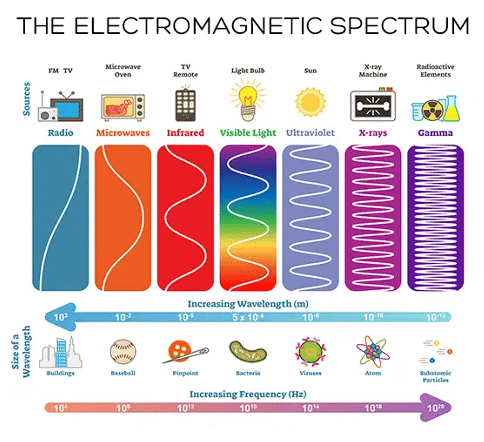
Electromagnetic radiation refers to a propagating stream of massless particles, called photons, travelling with wave-like behaviour at the speed of light (299,792.458 km/s).
Each photon contains a certain amount of energy. The different types of electromagnetic radiation are defined by the the amount of energy found in the photons.
Radio waves have photons with relatively low energies, microwave photons have more energy, infrared photons have still more, then visible, ultraviolet, X-rays, and the most energetic are gamma-rays produced by radioactive decay.
Spectrum Bands – what is frequency & wavelength
ref: https://lightcolourvision.org/diagrams/features-of-electromagnetic-waves/
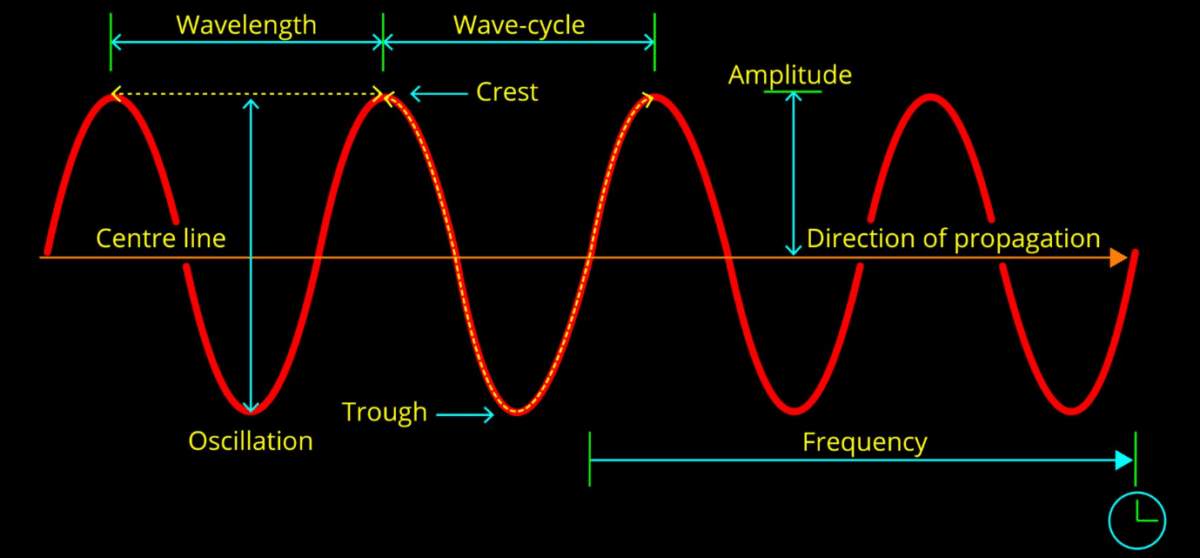
Wavelength
The distance between successive crests of a wave
Frequency
Wave cycles passing a given point in a given period of time
Amplitude
Measured between the crest and the mid-point of a wave
Velocity
Speed and direction of propagration
Spectrum Bands – Fibre Optic Attenuation
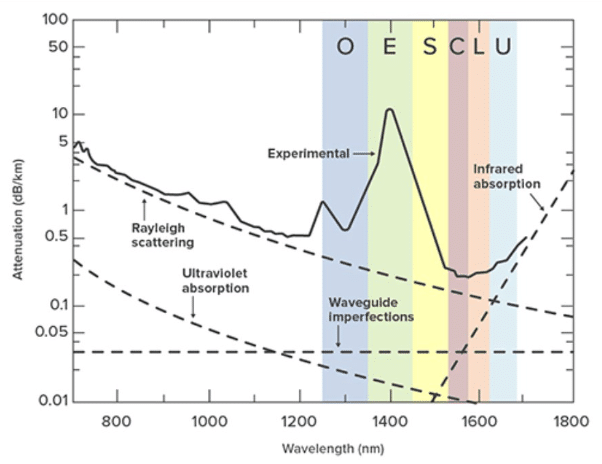
Light transmitted through fibre optics loses power over longer distances, referred to as “attenuation”.
The attenuation per kilometre varies depending on the wavelength of light, and is usually classified into specific transmission bands (for historical reasons).
As “C-Band” has the lowest attenuation per kilometre, it is usually preferred for long range transmission. Recently L-band is also used at times, however largely in terrestrial systems rather than subsea due to power constraints.
As the optical power degrades over distance, for long distance transmission the signal still needs be amplified periodically to boost its power so that it can be recovered at the far end.
Spectrum Bands – EDFAs
In the context of optical transmission, “Spectrum” refers to the range of frequencies/wavelengths that can be used to transmit data over the system – known as the”Passband” of the system. The Passband is typically limited by the frequency response of the amplifiers used in the system’s repeaters.
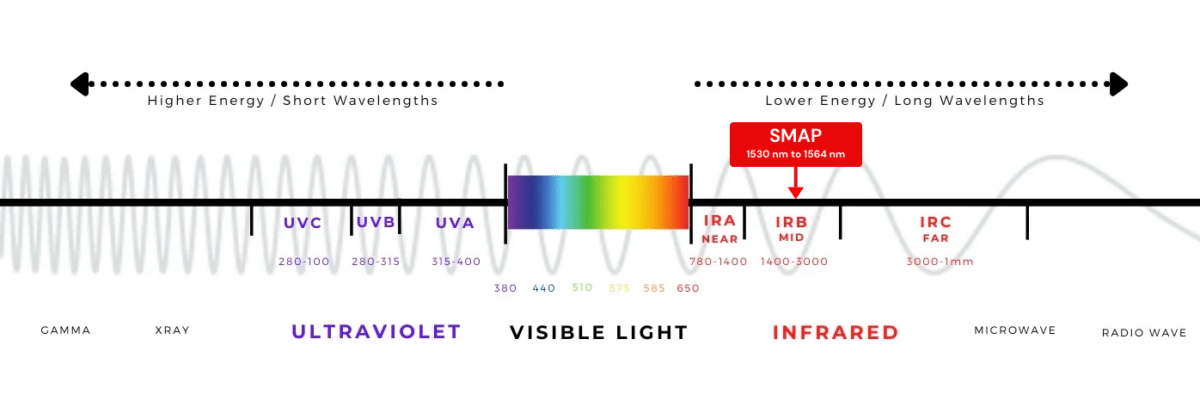
Most optical longhaul transmission systems use “Erbium Doped Fibre Amplifiers” (EDFA) to amplify optical signals within the “C-band”, which covers wavelengths from around 1530nm to 1565nm (or 100 times smaller than the thickness of a human hair!). The C-band falls within the mid-infrared part of the “light” portion of the electromagnetic spectrum, so is invisible to the human eye:
By a stunning coincidence, EDFA’s operating range falls within the lowest attenuation part of the spectrum for silica based fibre optics – which has enabled high capacity longhaul transmission over fibre optics!
The SMAP system passband is about 4500GHz (or 36nm) per fibre pair of usable “spectrum”.
In part 2, we’ll see how this spectrum can be used to deliver different types of services to customer.