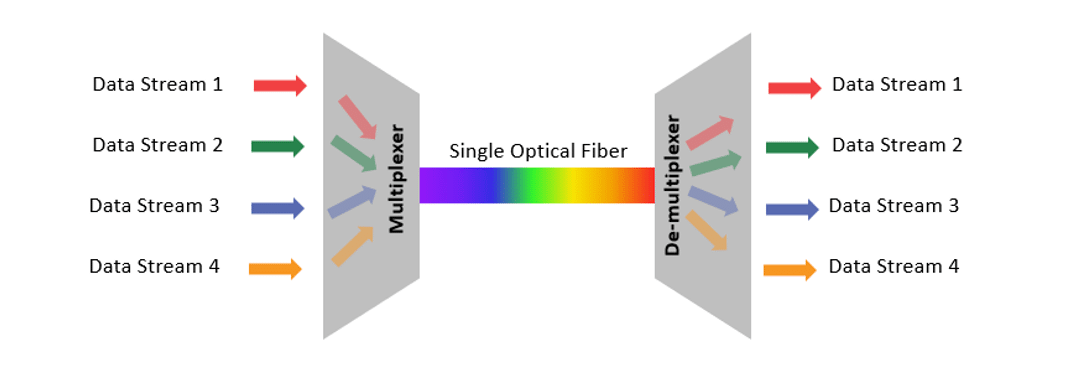
As the bandwidth of the entire cable system’s available spectrum passband is quite large (4500GHz in the case of SMAP) it is generally not practical with current technology to activate the entire available spectrum with a single device. Consequently, the spectrum is activated in discrete sub-units of spectrum called “wavelengths” or “channels” which occupy a smaller amount of spectrum around a specific centre frequency, hence being referred to colloquially as “wavelengths”. These channels are then mixed together prior to transmission over the cable system, in a process referred to as “wavelength division multiplexing”.
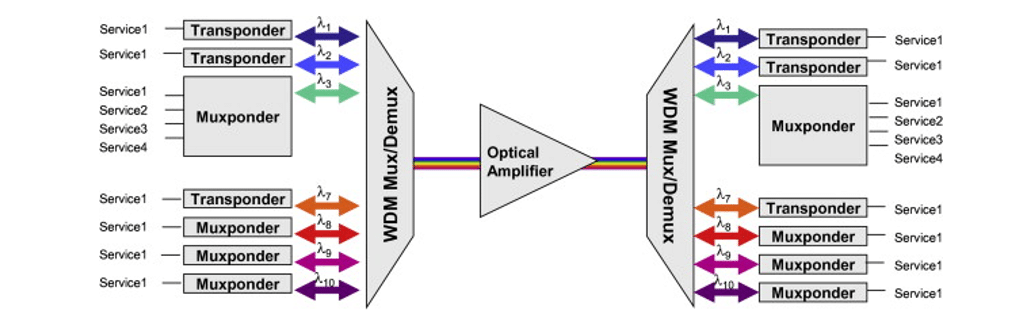
Optical signalling techniques used to transmit data over short distances are generally not suitable for long-haul transmission over a subsea cable system, even with amplification. In order to groom the incoming data streams and prepare them for transmission and recovery over a long-haul system a type of optical-electrical-optical “transponder” is used to carry out the necessary conversions.
A transponder generally takes a single incoming data stream/client interface and converts it to a single outgoing signal at a specific frequency, modulated in a form suitable for longhaul transmission. A “muxponder” (multiplexing transponder) is similar but takes various incoming client data interfaces and multiplexes them onto a single outgoing signal occupying a certain amount of spectrum/bandwidth.
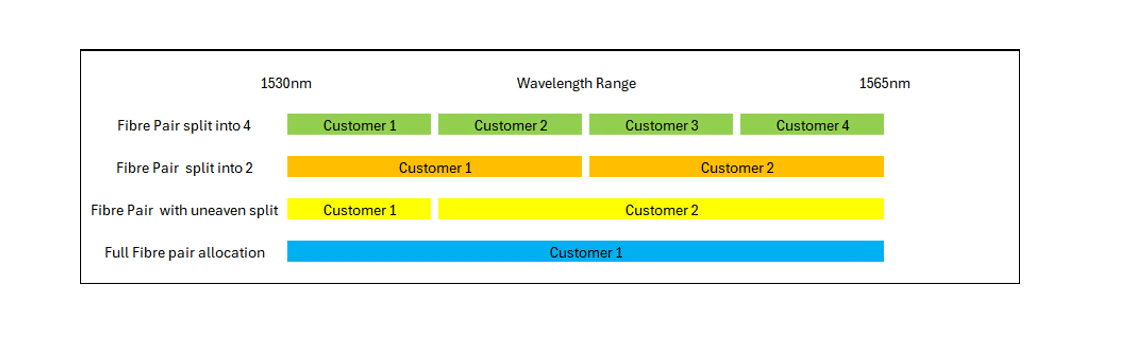
Historically, the entire system passband of a subsea cable system was activated (referred to as “lit”) by the system owner/operator with their own transponders or muxponders. The subsequent client data interface capacity was used either for their own purposes or on-sold to third parties as the classical “wavelength” type of carrier service, i.e. a point-to-point service with dedicated capacity over the cable system. Alternatively, a whole fibre pair could be on-sold to a third party for them to light.
Any channels not lit at time of commissioning are typically filled with optical noise (referred to as “Amplified Spontaneous Emission”, or ASE) at similar power levels as the active channels would be – to avoid any changes to both the aggregate optical power and the distribution of power across the spectrum on the fibre over the life of the system, which could otherwise cause unwanted changes in system performance.
A new paradigm emerged with the concept of “Spectrum Sharing” and “Open Cables”, whereby the available spectrum on the cable system is divided between a number of parties for them to light with their own transponders. The Indigo Cable Systems were one of the first instances of this in Australia! This required several advances in cable system design to support the interoperability of different vendor’s transponders across the available spectrum.
Spectrum sharing enabling technologies:
- Wavelength Selective Switch (WSS)/Reconfigurable Optical Add/Drop Multiplexor (ROADM)
- Open Cable Systems – cable system independence from transponder vendor (previously were bundled),
- Tuneable coherent transponders.
Benefits of Spectrum Sharing:
- Good for customers that don’t need a whole fibre pair but want a significant portion a fibre pair’s capacity.
- Customer can optimise their transponder deployment to suit their needs, e.g.:
- Lower cost vs higher capacity,
- Required features,
- Take advantage of upgrade cycles independently.
- Potential option to resize spectrum as required.
- More secure – less chance of interception outside of customer’s network.
- Less susceptibility to service provider maintenance on their transponders – manage your own maintenance schedule.
Risks of Spectrum Sharing:
- Potential for transient impairments from other spectrum customer channel changes on the same fibre pair.
- Requires management of total power and power spectral density between spectrum parties.
- Spectrum customers require expertise in operating and maintaining their own transponders and any associated optical line systems.
Example Scenarios: