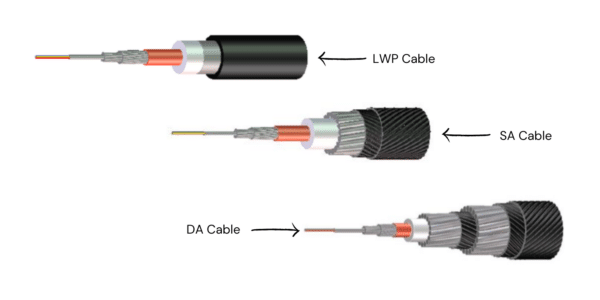
The SMAP cable system will have over 5200km of subsea cable across its trunk (Sydney to Perth) and branches (Melbourne and Adelaide). We’ve looked briefly before at cables and repeaters, but since our manufacturing is approaching 100% completion, today we’re going to do a deep dive into how a submarine cable is made.
A Subsea Cable has two primary functions:
- Transmit light over optical fibres with fidelity suitable for data transmission
- Conduct electrical current to power the system’s repeaters
A host of secondary requirements emerge based on the environmental considerations for deployment, operation and repair, e.g.:
- Sufficient tensile strength to withstand stresses during cable deployment: handling and laying from a cable ship, operation: seafloor currents, suspensions arising from seafloor movement, and cable recovery: during repairs.
- Insulation resistance: to prevent electrical current from leaking to the seafloor at the high voltages present (over 10kV for SMAP in single end feeding!)
- Handling/laying ability: resistance to kinks and loops under typical handling and laying procedures
- Pressure resistance: to water depths of up to 8,000m
- Corrosion resistance: to seawater and other possible seafloor environments
- Crush and cut resistance: from external aggression, e.g.: anchors, rockfall, fishing lines.
In order to meet the first primary function (transmit light) you need optical fibres. Single-mode Optical Fibre (SMOF) is best suited to long-haul transmission due to its low attenuation and ability to make use of Erbium Doped Fibre Amplifiers around the 1550nm wavelength (as covered in our Repeaters hit 100% Completion blog post).
A typical single mode fibre has the following dimensions:
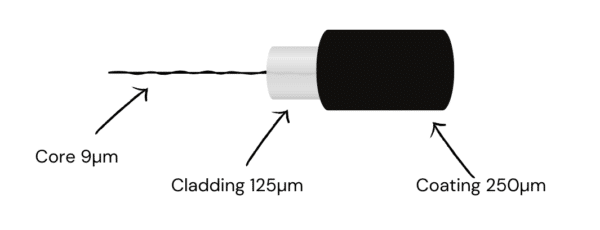
The core and cladding are continuous silica glass with differing refractive indexes due to the different dopants added during the manufacturing process. The coating is usually acrylate or some other kind of polymer. A softer inner coating (for shock resistance) and harder outer coating (for wear resistance) are often used. Raw optical fibres are often manufactured separately from the cable they are ultimately housed in.
Raw Fibre Manufacturing steps:
- High purity silica glass is formed into a hollow tube with different dopants added at different stages to manipulate the refractive index needed for the core and cladding layers. This doped hollow tube of highly pure silica glass is referred to as a “preform”.
- The preform is then sintered (heated and pressed) into a solid glass “optical fibre blank” ready for drawing into fibres.
- The preform/blank is suspended in a drawing tower, heated to over 2000C and drawn into the ultimate fibre dimensions (125μm diameter)
- The raw fibre is coated with a thin protective coating (buffer) as part of the drawing process, bringing coated fibre diameter to ~250μm
- Finished optical fibres are then wound onto spools, in lengths ranging from 50-250km, depending on the requirements of the cable manufacturer.
- Raw optical fibre spools are then sent to the cable manufacturer for integration into the desired cable assembly.

Subsea Cable manufacturing:
Light Weight (LW) Cable – this is the basis for all other cable types.
- Raw fibres are first dyed according to the system’s colouring scheme.
- The coloured fibres are then enclosed in a continuous seam-welded stainless-steel or polybutylene terephthalate (PBT) tube. Thixotropic gel surrounds the raw fibres inside the tube to insulate them from shock and to prevent water ingress.
- The tube is then wrapped in steel wires forming a pressure vessel/vault – the gaps between the steel wires are filled with a water-blocking compound to prevent water ingress along the cable. The steel wires also provide the tensile strength of the cable.
- Copper tape is then seam welded and formed onto to the wire vault to make up what is referred to as the “composite electrical conductor” – using both the copper and steel wire to conduct the electrical current used to power the repeaters.
- Finally, a polyethylene layer is bonded to the copper tape to insulate the conductor from sea at the high voltages present and provide some abrasion resistance.
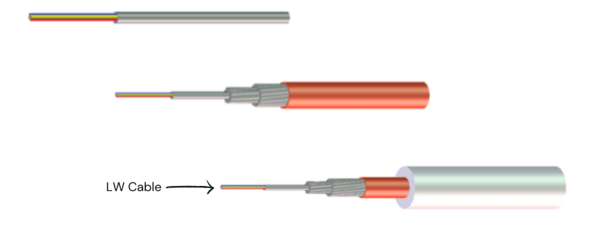
Light Weight Protected (LWP) Cable – starts with same LW Cable base and adds steel tape and black high density polyethylene outer sheath for additional abrasion resistance.
Single Armour (SA) / Double Armour (DA) Cable – starts with same LW Cable base and adds one or two layers of galvanised steel wire covered with bitumen/tar and wrapped with an outer nylon or polypropylene yarn. This is used to protect the cable in shallow/high risk waters.
The SMAP cable system only makes use of LWP for better cable armouring, and will be the first fully armoured submarine cable in the world.