Until the turn of the 21st century, fibre optic networks typically carried only a single wavelength per fibre. The capacity of that wavelength was shared among multiple customers using Time-Division Multiplexing (TDM) technologies like Synchronous Digital Hierarchy (SDH). In TDM, a customer’s capacity is allocated dedicated ‘timeslots’ on the wavelength. For example, if a wavelength was 2.48Gbps (or an STM-16), a customer might be allocated 620Mbps (STM-4) of capacity which is ¼ of the total time slots available.
With the advent of Dense Wavelength Division Multiplexing (DWDM), a single fibre could now carry multiple wavelengths, significantly increasing capacity. This breakthrough made it possible to dedicate entire wavelengths to individual customers, giving rise to the development of so-called ‘wavelength’ products alongside the broader adoption of DWDM technology.
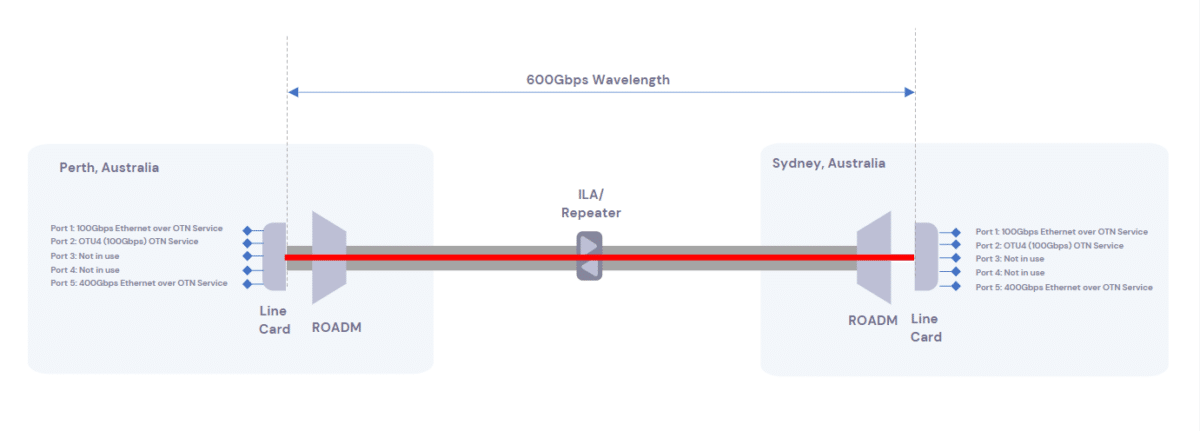
In the early days of DWDM, production wavelengths offered capacities of around 2.5Gbps. Today, the capacity of a single wavelength, such as those on the SMAP cable system, can reach up to 1Tbps. A single terabit-scale wavelength often exceeds the requirements of an individual customer. To address this, modern DWDM hardware now uses the same TDM concepts to divide a 1Tbps wavelength into smaller capacities tailored to customer needs. SUBCO can thus offer services at rates such as 100Gbps, 400Gbps, or 800Gbps across SMAP.
This modern TDM division of wavelength capacity uses a new Optical Transport Networking (OTN) protocol. OTN serves as a digital wrapper, encapsulating multiple client signals—such as 100Gbps, 400Gbps, or 800Gbps rates—into larger aggregated signals for efficient transport over SMAP’s high-capacity wavelengths.