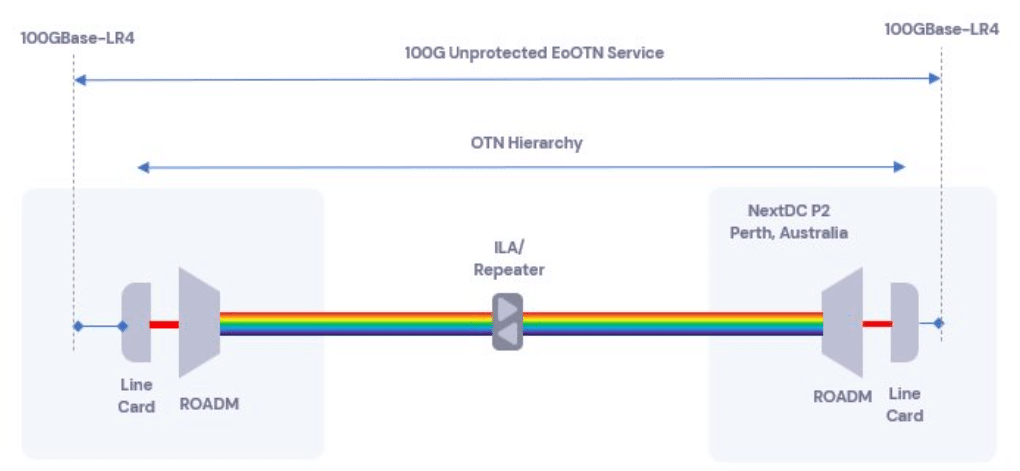
While OTN discussed in our previous blog defines its own OTN Client interfaces, it also includes a standard on how it can be used to transport foreign client types such as Ethernet, SDH and Fibre Channel.
The most common type of client signal carried across SUBCO wavelengths are Ethernet services. SUBCO refers to Ethernet services transported over wavelengths as Ethernet over OTN (EoOTN).
Ethernet frames from our customers are encapsulated in the OTN digital wrapper and transported directly over wavelengths across our subsea systems, including the upcoming SMAP cable.
Services like this are given their own dedicated capacity on a wavelength which, unlike switched ethernet networks, is not subject to oversubscription or variable forwarding delays. The relatively small number of layers between the ethernet service and the optical layer also ensures low and predictable latency in the transmission of long-haul data.
EoOTN networks do not participate in the layer 2 forwarding of frames and transparently pass all ethernet frames received (even errored frames) through to the far end in a similar way to a dark fibre. This also means ethernet layer2 control protocols are transparently passed through the network, allowing support for the likes of Spanning Tree Protocol or Link aggregation control protocol.